
 Talk to an Expert
Gap Year Medicine Applicants
Gap Year & Reapplication Support for Medicine Applicants
Not getting an offer the first time round doesn't mean you're not capable of getting into medical school - it usually means one part of the application needs a genuinely different approach the second time, not just more of the same. Dr. Kishan Manani, a qualified medical doctor and the founder of Medpathway Tutors has spent over six years supporting both gap year applicants and reapplicants, helping them work out exactly what to change before they apply again.
Why a Gap Year Application Is Different
Whether you’re taking a planned gap year or reapplying after an unsuccessful cycle, medical schools will expect to see growth since your last application – not just the same personal statement with a new date on it. Admissions tutors are generally looking for evidence that you’ve reflected honestly on what didn’t work, gained new relevant experience, and, where needed, improved your UCAT score or academic profile.

Common Reasons Applications Don’t Succeed First Time
- A UCAT score below the threshold most target universities use for shortlisting
- A personal statement that lists experiences without reflecting on them
- Limited or dated work experience and volunteering
- Underperforming at interview or MMI stage despite a strong application on paper
- Applying to a set of universities that didn’t suit your particular strengths
Our Approach to Gap Year & Reapplication Support
- An honest review of your previous application to identify exactly what likely held you back
- A structured plan for the gap year itself – work experience, volunteering, and any academic gaps to close
- Updated UCAT preparation if your score needs to improve
- A rebuilt personal statement reflecting genuine new experience and growth, not a reworded old draft
- Interview and MMI coaching addressing whatever went wrong last time, specifically
- Support choosing a university list that better matches your profile second time round
What’s Included
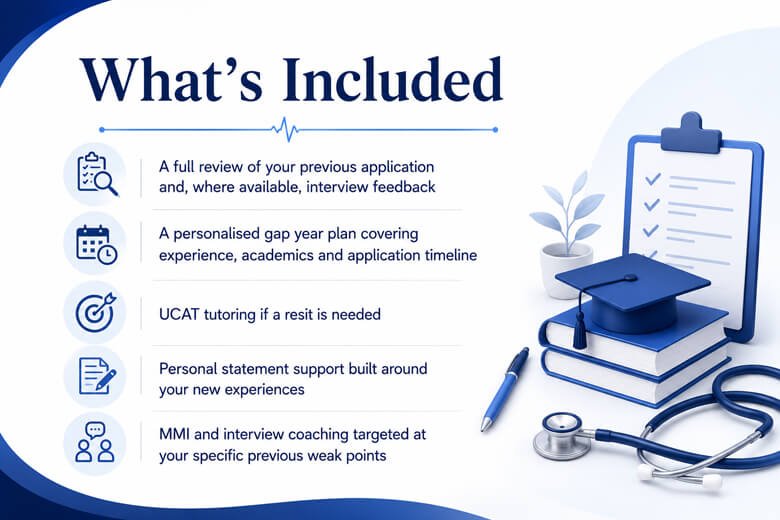
- A full review of your previous application and, where available, interview feedback
- A personalised gap year plan covering experience, academics and application timeline
- UCAT tutoring if a resit is needed
- Personal statement support built around your new experiences
- MMI and interview coaching targeted at your specific previous weak points

Who This Is For
- Students who didn’t receive an offer this cycle and are reapplying
- Students taking a planned gap year before their first medicine application
- Applicants who reached interview but weren’t successful, and want to understand why
- Students considering a resit of A-Levels or the UCAT as part of a stronger reapplication
Frequently Asked Questions
No – many successful medical students reapplied at least once. What matters is being able to show genuine reflection and improvement since your last application, rather than submitting a near-identical one.
That depends entirely on your circumstances – some students take a planned gap year regardless of outcome, to strengthen work experience or improve their UCAT before applying. This is worth discussing individually rather than following generic advice.
Start with honest feedback if the university provided any, and work backward from there – often it’s a specific, fixable issue (structure, confidence, a particular station type) rather than a fundamental problem with your suitability for medicine.
Yes – if a resit is the right move for your situation, this is built into your gap year plan alongside personal statement and interview preparation.
Ready to Plan Your Next Application?
Book a free 30-minute consultation to talk through what happened last time and build a plan for a stronger application.