
 Talk to an Expert
Medicine Personal Statement Support
Medicine Personal Statement Help & 1-to-1 Support
Since UCAS restructured the personal statement into three set questions, medicine applicants have less room than ever to get their answers right - every sentence has to earn its place inside a shared 4,000-character limit. Dr. Kishan Manani, a qualified medical doctor and the founder of Medpathway Tutors wrote his own successful personal statement en route to offers from St Andrews and Manchester, and has spent over six years since then helping other medicine and dentistry applicants shape theirs, now fully updated for the current UCAS format.
The UCAS Personal Statement Has Changed – Here’s What That Means for You
From the 2026 entry cycle onwards (which includes the current 2027-entry cycle), UCAS replaced the old single, free-text personal statement with three structured questions, answered separately but read together by admissions tutors as one statement:
- Why do you want to study this course or subject?
- How have your qualifications and studies helped you prepare for this course or subject?
- What else have you done to prepare outside of education, and why are these experiences useful?
You still have 4,000 characters in total, shared across all three answers however you choose to divide them, with a minimum of 350 characters required per question. The content medical schools are looking for hasn’t fundamentally changed – genuine motivation, real reflection on work experience and volunteering, and evidence of wider reading – but the structure now makes it much easier for admissions tutors to spot statements that repeat themselves across sections, so planning matters more than ever.

Why Your Personal Statement Still Matters
Many medical schools use your personal statement as a basis for interview questions, and some still weight it as part of shortlisting alongside your UCAT score and academic record. A statement that clearly answers all three UCAS questions – with specific, reflective detail rather than a list of achievements – gives you a real advantage over applicants who treat it as an afterthought.

How Personal Statement Support Works
- An initial planning session to map your experiences against the three UCAS questions before you write a single word
- Guidance on which experiences to prioritise – reflection matters more than volume
- Line-by-line feedback on drafts, focused on clarity, structure and avoiding repetition across the three sections
- Honest, specific feedback – not just “this reads well”, but exactly what to change and why
- A final proofing pass before you submit
What’s Included
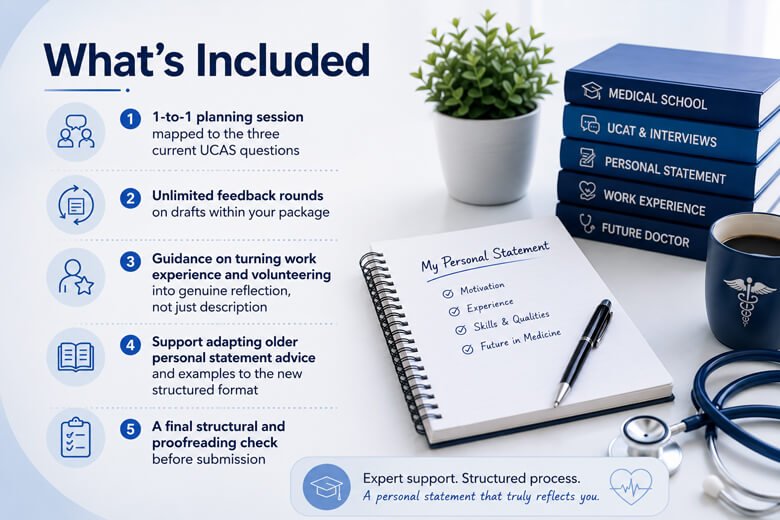
- 1-to-1 planning session mapped to the three current UCAS questions
- Unlimited feedback rounds on drafts within your package
- Guidance on turning work experience and volunteering into genuine reflection, not just description
- Support adapting older personal statement advice and examples to the new structured format
- A final structural and proofreading check before submission

Who This Is For
- Reapplicants who want a stronger, more reflective statement second time around
- International students unfamiliar with what UK admissions tutors are looking for
- Students who have a first draft but aren’t sure if it actually answers what UCAS is asking
Frequently Asked Questions
Yes – medical schools still read all three answers together as your personal statement, and many still use it as the basis for interview questions. The format has changed, but its importance to your application hasn’t.
There’s no fixed length per question beyond the 350-character minimum – you have 4,000 characters to divide across all three however best reflects your experiences, though most strong statements give reasonably balanced weight to each.
Yes – many students already have reflections and examples from an earlier draft. Support includes helping you map that existing material onto the three current UCAS questions rather than starting from a blank page.
Yes – the same three-question UCAS format and preparation approach applies to dentistry applications; see our Dentistry programme page for course-specific guidance.
Ready to Start Your Personal Statement?
Book a free 30-minute consultation and we'll map out your three UCAS answers together before you write a single draft.