
 Talk to an Expert
MMI Interview Preparation
MMI Interview Preparation & Medical School Interview Coaching
The Multiple Mini Interview (MMI) is how most UK medical and dental schools now assess applicants at interview stage - and it's a format that rewards preparation far more than raw talent. Dr. Kishan Manani, a qualified medical doctor and the founder of Medpathway Tutors went through the MMI process himself en route to offers from St Andrews and Manchester, and has spent over six years coaching applicants through MMI Mock Circuits, ethical scenario training, and communication-station practice.
What Is an MMI (Multiple Mini Interview)?
Instead of one long interview with a single panel, an MMI is a circuit of short stations – typically 5 to 10 minutes each – where you move from room to room, facing a different scenario, question set, or task at every stop. Stations commonly assess ethical reasoning, communication and empathy, teamwork, problem-solving, and your motivation for medicine or dentistry, often through role-play with an actor rather than a straightforward Q&A.
Why MMI Preparation Matters
Most students who underperform at MMI don’t lack knowledge – they lack exposure to the format itself. Common issues include over-rehearsed answers that fall apart the moment a station asks something unexpected, weak structure under time pressure, and difficulty adapting tone between a formal ethics station and a role-play scenario. Targeted MMI practice fixes all three.
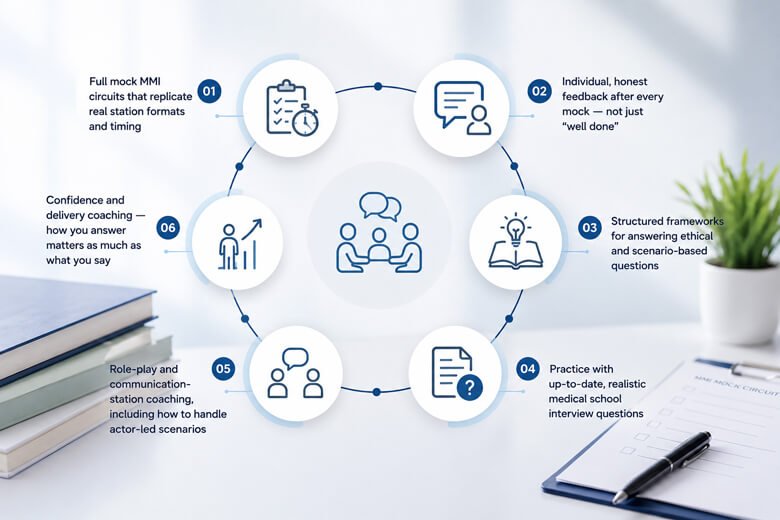
Our MMI Coaching Process
- Full mock MMI circuits that replicate real station formats and timing
- Individual, honest feedback after every mock – not just “well done”
- Structured frameworks for answering ethical and scenario-based questions
- Practice with up-to-date, realistic medical school interview questions
- Role-play and communication-station coaching, including how to handle actor-led scenarios
- Confidence and delivery coaching – how you answer matters as much as what you say
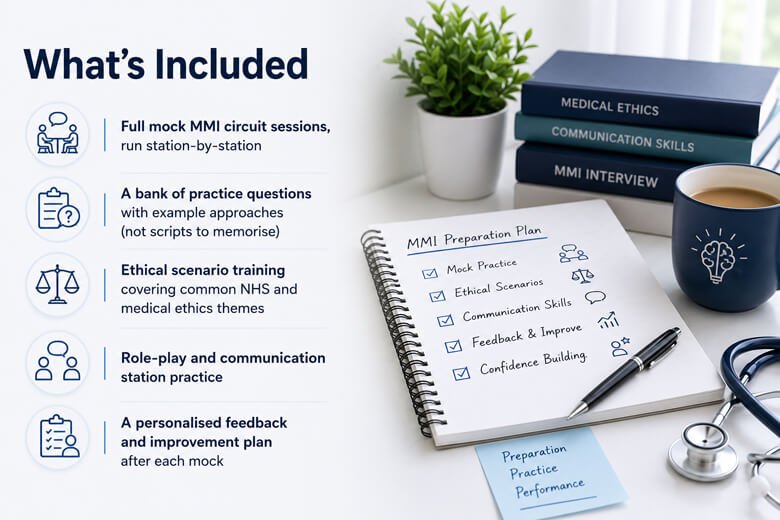
What’s Included
- Full mock MMI circuit sessions, run station-by-station
- A bank of practice questions with example approaches (not scripts to memorise)
- Ethical scenario training covering common NHS and medical ethics themes
- Role-play and communication station practice
- A personalised feedback and improvement plan after each mock
Medical School Interview Questions: What to Expect
While every school’s stations differ, most MMI circuits draw from a similar pool of themes: your motivation for medicine or dentistry, insight from work experience and volunteering, ethical dilemmas relevant to healthcare, teamwork and communication scenarios, and personal insight questions about resilience or handling setbacks. Coaching focuses on building a flexible approach to each theme, rather than trying to predict exact questions – since MMI stations are specifically designed to resist scripted answers.
Who This Is For
- medicine and dentistry applicants facing MMI-format interviews
- Students preparing for traditional panel interviews, which share many of the same underlying skills
- International students preparing for UK-style interview formats and expectations
- Applicants who’ve had an unsuccessful interview before and want to understand what to change
Frequently Asked Questions
An MMI splits the interview into multiple short, independently-scored stations, each testing a different skill. A traditional panel interview is usually one longer conversation with the same interviewer(s) throughout. Many of the same underlying skills – clear communication, structured thinking, genuine reflection – matter for both.
Most students benefit from 3–5 full mock circuits in the weeks leading up to interview, spaced out so there’s time to work on feedback between each one, rather than cramming them all in the final week.
Yes – mock circuits and coaching sessions are run over video call, which works well for both UK-based and international students preparing for the same UK medical school interviews.
Yes. Dentistry interviews follow a very similar MMI format, often with additional stations on manual dexterity awareness and dental-specific ethical scenarios – see our Dentistry programme page for more detail.
Ready to Prepare for Your MMI Interview?
Book a free 30-minute consultation to talk through your interview date, target schools, and where to focus your preparation first.